Fast Online Personal Loans for Credit Card Debt Consolidation with Instant Approval

Juggling multiple credit card statements each month, each carrying compounding, double-digit interest rates, can quickly drain your monthly cash flow. What feels like manageable spending can easily spiral into a cycle where most of your hard-earned money goes toward interest charges rather than reducing the actual principal balance.

For consumers trapped in this cycle, fast online personal loans offer a streamlined path forward. By rolling multiple high-interest balances into a single, predictable monthly payment, debt consolidation can simplify your finances. However, while securing an online consolidation loan with instant pre-approval provides immediate psychological relief and potential interest savings, understanding the qualifying criteria and long-term financial discipline required is crucial for true success.

How Fast Online Pre-Approval Works for Debt Consolidation

The digital lending landscape has transformed how borrowers tackle high-interest debt, replacing tedious paperwork with rapid, automated pre-qualification tools.

  • Soft Credit Check Pre-Qualification: When you apply online, modern lenders typically

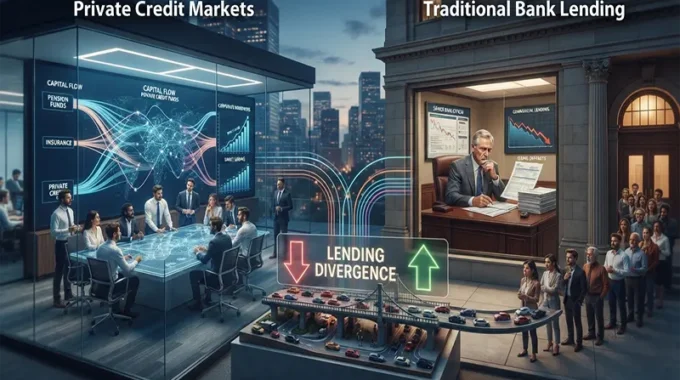
Corporate Funding Migration to Private Credit Markets and the Impact on Traditional Bank Lending

The post-banking-crisis era, paired with a prolonged higher-interest-rate environment, has permanently altered how corporations raise debt capital. For decades, commercial banks and public syndicated loan markets served as the undisputed gatekeepers of corporate finance.

Today, that landscape is undergoing a massive structural shift. A tidal wave of corporate funding is migrating away from traditional banking institutions toward private credit and direct lending funds. As private debt asset pools swell into trillions of dollars, traditional bank lending is being squeezed, forcing commercial institutions to fundamentally rethink their underwriting models, syndication desks, and corporate banking relationships.

Macro Drivers Fueling the Private Credit Boom

The rapid expansion of private credit is not a temporary market aberration; it is driven by powerful macroeconomic and regulatory forces.

  • Regulatory Squeeze on Commercial Banks: Following tighter post-crisis regulations (including Basel III and emerging Basel IV capital frameworks), holding corporate loans on bank balance sheets has become significantly

World Finance Personal Loan Requirements for Income Verification and Debt-to-Income Ratio

Securing a personal loan depends less on a single credit score and more on a holistic evaluation of your financial stability. While traditional prime-tier banks rely heavily on automated algorithms that penalize fair credit or thin files, lenders like World Finance take a more personalized, relationship-driven approach to underwriting.

At the core of this evaluation are two critical metrics: verifiable income stability and your debt-to-income (DTI) ratio. Understanding how World Finance reviews these factors empowers borrowers to prepare accurate documentation, protect their household budgets, and improve their overall approval odds.

The Importance of Income Verification

For installment lenders specializing in fair-credit or non-prime markets, verifying steady cash flow is the single most important indicator of a borrower’s ability to repay a loan. Without proof of reliable income, even a stellar credit history will fall short.

  • Acceptable Forms of Income: World Finance evaluates diverse streams of revenue beyond traditional corporate employment.

How Extreme Heat Hazards and Carbon Taxes Are Changing Workplace Operations

For generations, corporate operational strategy treated the physical environment as a constant. Offices, warehouses, and factories were designed around stable baseline climates, and energy consumption was viewed purely through the lens of utility costs. Today, that operational certainty has evaporated.

Modern organizations face the convergence of two powerful, escalating forces: accelerating extreme heat hazards that threaten worker safety and labor capacity, and expanding carbon taxes that penalize emissions-heavy facility management. To survive and thrive in this new operating environment, businesses must fundamentally adapt their physical infrastructure, shift work scheduling, and decarbonize their operational footprints.

The Operational Impact of Extreme Heat Hazards

Rising global temperatures and frequent, prolonged heatwaves are no longer just environmental concerns; they are critical workplace safety liabilities that directly impair productivity and human capital.

  • Labor Capacity and Health Risks: As wet-bulb temperatures and ambient heat rise, physical exertion outdoors or in non-climate-controlled facilities (such as warehouses, manufacturing

How Investment Banks Are Deploying Agentic AI Workflows for Automated Trade Accounting

For years, the financial services sector approached artificial intelligence with caution, relegating digital tools to passive generative chatbots or rigid, rule-based automation scripts. While these technologies assisted with drafting reports or sorting basic customer data, they remained fundamentally limited when applied to the high-stakes, high-volume environment of investment banking back-offices.

Today, that paradigm is shifting rapidly. Major investment banks are moving beyond simple automation to deploy autonomous agentic AI workflows. Unlike static software, agentic systems possess the capacity for multi-step reasoning, dynamic tool usage, and self-correction. By embedding these intelligent agents into trade accounting, financial institutions are transforming a historically labor-intensive, error-prone cost center into a streamlined, high-speed strategic engine.

From Rule-Based Automation to Autonomous Agentic Frameworks

To understand the magnitude of this transition, it is helpful to look at how back-office operations have evolved.

  • The Limits of Legacy RPA: Traditional Robotic Process Automation (RPA) and rigid macro scripts